Author Biography

Derek Miller is a seasoned automotive technician based in Colorado who brings over 12 years of hands‑on expertise to every engine bay he opens. From his first summer job sweeping floors at a neighborhood repair shop to leading major diesel performance upgrades, Derek has built a reputation for practical problem‑solving, meticulous attention to detail, and a friendly, customer‑first approach.

Background & Early Career

Derek grew up tinkering alongside his father's old Chevy pickup, learning how to swap spark plugs and patch leaky hoses before he could drive. Fresh out of school, he dove into the garage world full‑time. By his mid‑20s, he was the go‑to mechanic for friends, neighbors, and local small‑fleet operators.

Career Progression

Shop Lead

At age 28, Derek was promoted to lead technician. He managed a four‑bay team and trained new hires in best practices for engine diagnostics, safety protocols, and high‑torque drivetrain alignment.

Independent Specialist

Eager to tackle complex diesel jobs, he branched out as an independent consultant, focusing on heavy‑duty pickups, commercial vans, and small industrial equipment. He’s consulted on everything from truck maintenance schedules to 24‑hour emergency repair programs for local delivery fleets.

Performance & Reliability Expert

Over the last five years, Derek has specialized in performance tuning for Ford F‑Series and GM Sierra trucks, blending factory‑grade scan‑tool diagnostics with carefully calibrated aftermarket modules to boost power without sacrificing longevity.

Diesel Performance Upgrades: Skilled in recalibrating ECM parameters and optimizing exhaust system modifications to extract up to 30% more torque while maintaining fuel efficiency and reliability.

Preventive Maintenance: Designs fleet‑wide maintenance plans that reduce unplanned downtime by up to 40%.

Customer Communication: Known for breaking down technical issues into clear, jargon‑free explanations and offering cost‑effective repair options.


Articles
May 02, 2026

LMM Duramax Delete Kit Buyer's Guide (2007.5–2010)

If you own a 2007.5–2010 Chevy Silverado HD or GMC Sierra HD with the 6.6L LMM Duramax, chances are you've already dealt with at least one emission system headache: a clogged DPF, a cracked EGR cooler, or that gut-punch moment when your truck drops into reduced engine power mode with a load on the trailer. This guide breaks down everything you need to know before buying an LMM Duramax delete kit: what's in the box, what hardware fits, how the tune works, and what kind of real-world performance gains you can expect.
April 29, 2026

Common 6.7 Cummins DPF Problems and Upgrade Paths

If you own a Ram 2500 or 3500 with a 6.7L Cummins, there's a good chance you've already stared at a DPF warning light, sat through a regen cycle that wouldn't end, or gotten a repair estimate that made your eyes water. The diesel particulate filter is one of the most talked-about pain points in the Cummins community, and for good reason. This guide breaks down exactly what goes wrong, how to diagnose it, and what your real options are for fixing it for good.
April 30, 2026

LML Duramax Delete Kit Buyer's Guide (2011–2016 Silverado & Sierra)

If you own a 2011–2016 Chevy Silverado 2500HD or GMC Sierra 2500HD/3500HD with the 6.6L Duramax LML, you already know the drill. The check engine light lives on the dash. Active regen kills your fuel economy on every long haul. And if you've hit 100,000 miles, your EGR cooler or DPF is probably already a problem, or it's about to be. The LML is one of the strongest diesel engines GM ever built. The problem isn't the engine itself. It's the emissions hardware strapped to it. This buyer's guide breaks down exactly what's in a complete LML Duramax delete kit, what fails and why, and what you need to do a clean, one-and-done delete on your truck.
April 28, 2026

6.7 Powerstroke Delete Pipe vs Full Delete Kit: Which One Do You Actually Need?

If you're shopping for emissions delete parts for your Ford Super Duty, you've probably run into both terms: delete pipe and full delete kit. They sound similar, but they're very different in scope, cost, and what you actually get out of them. Buy the wrong one and you're either leaving performance on the table or wasting money on a partial fix that still throws codes and puts your truck in limp mode. This guide breaks down exactly what each option includes, what it doesn't, and how to decide which is right for your build and budget.
April 27, 2026

2004.5–2005 LLY Duramax Buyer's Guide: Specs, Common Problems & Best Upgrades

If you've been shopping for a used heavy-duty Chevy Silverado or GMC Sierra and landed on a 2004.5–2005 model, there's a good chance you're looking at a 6.6L LLY Duramax under the hood. Honestly, that's not a bad place to be. The LLY sits in an interesting spot in Duramax history: more accessible and serviceable than the LB7 that preceded it, but without the complex emissions burdens that started piling on with the LMM and beyond. No DPF. No DEF. No regen cycles eating your fuel mileage. Just a straightforward 6.6L diesel that, with the right upgrades and maintenance, can haul heavy and keep running well past 300,000 miles. But the LLY isn't without its quirks. This guide covers everything you need to know before buying, maintaining, or building one. We will walk from factory specs and known failure points to the smartest upgrades you can make for performance and long-term reliability.
April 24, 2026

Common 6.7 Powerstroke DPF Problems and Upgrade Paths

If you own a 2011–2024 Ford Super Duty, odds are you've already had a conversation with your DPF, usually the kind that starts with a dashboard light and ends with a shop quote. The 6.7L Powerstroke is one of the strongest diesel platforms Ford has ever built, but its emissions hardware is also one of the most common reasons these trucks end up in the bay. Regen cycles that never finish, cracked filters, oil dilution, and limp mode all trace back to the same place. This guide breaks down how the DPF works on the 6.7, the failure modes owners run into most often, how to diagnose them, and the repair and upgrade paths that actually solve the problem instead of just resetting the clock.
April 23, 2026

2007.5-2010 LMM Duramax Buyer's Guide

If you are in the market for a used heavy-duty Chevy Silverado or GMC Sierra 2500HD/3500HD, the 2007.5 to 2010 LMM Duramax is likely on your radar. Following in the legendary footsteps of the revered LBZ, the 6.6L LMM Duramax shares the same robust architecture, the same bulletproof Allison 1000 6-speed transmission, and the same aggressive V8 grunt. But there's a catch: the LMM marked the official dawn of the modern emissions era for General Motors. To meet stringent EPA regulations introduced in mid-2007, GM strapped a Diesel Particulate Filter (DPF) and a heavily revised Exhaust Gas Recirculation (EGR) system onto the LBZ's bones, creating the LMM. While the engine itself is a powerhouse, these early bolt-on emissions systems became the Achilles' heel of an otherwise stellar drivetrain. Whether you're looking to buy your first LMM, or you already own one and want to know how to bulletproof it for the next 200,000 miles, you are in the right place. In this comprehensive buyer's guide, we are breaking down exactly what fails, why it happens, and how the right 2007.5-2010 LMM Duramax parts can transform this choked-up workhorse into a reliable tow rig.
April 20, 2026

Ford Diesel Engines to Avoid: Problem Years, Common Issues

If you're shopping for a used Ford diesel pickup, you've probably already heard some horror stories. Maybe a buddy dropped $8,000 into a Super Duty he paid $15,000 for. Maybe you've seen forum threads that go on for 200 pages about coolant in the oil. There's a reason those threads exist, and it's not bad luck. Ford has built some genuinely excellent diesel engines over the years. But it has also produced a few that have become legends for all the wrong reasons. Before you hand over a check for that used F-250 or F-350, here's what you need to know.
April 19, 2026

Duramax Delete Kit Buyer's Guide: Everything You Need to Know

If you've owned a 6.6L Duramax long enough, you already know the drill. The DPF clogs. The EGR cooler cracks. The DEF system throws codes at the worst possible time, usually loaded down, miles from nowhere. At some point, every serious Duramax owner starts asking the same question: what's in a delete kit, and which one do I actually need? This guide breaks it all down by generation (LBZ, LMM, LML, and L5P) so you can shop with confidence and stop guessing.
April 18, 2026

2013–2018 6.7 Cummins Delete Kit Buyer's Guide

If you're running a 2013–2018 Ram 2500 or 3500 with the 6.7L Cummins, you already know what this engine is capable of. You also know what stands in its way: a stacked emissions system that throws codes, forces regen cycles at the worst possible time, and silently costs you horsepower and fuel economy every single mile. This buyer's guide breaks down exactly what changed on the 2013+ Cummins, what the complete delete involves, how fitment breaks down year by year, and what to expect once everything is removed and tuned. Whether you're a daily driver, a serious tower, or running your truck off-road full time, this is the guide before you buy.
April 17, 2026

6.7 Cummins Delete Kit Buyer's Guide: Everything You Need Before You Buy

If you've been running a 6.7 Cummins for any length of time, you already know the drill. The truck pulls hard, tows well, and gets respectable fuel economy — until the emissions system starts throwing codes. Whether it's a clogged DPF, a failed EGR cooler, or a DEF pump that decides to quit at 120,000 miles, the downstream costs add up fast. A complete delete kit is how most Cummins owners take back control of their truck and stop feeding the dealership's service department. This guide breaks down exactly what's in a full 6.7 Cummins delete kit, which parts apply to your year, what kind of performance gains you can realistically expect, and how to pick the right setup for your build.
April 16, 2026

6.7 Powerstroke EGR Problems: Symptoms, Causes, and Fixes

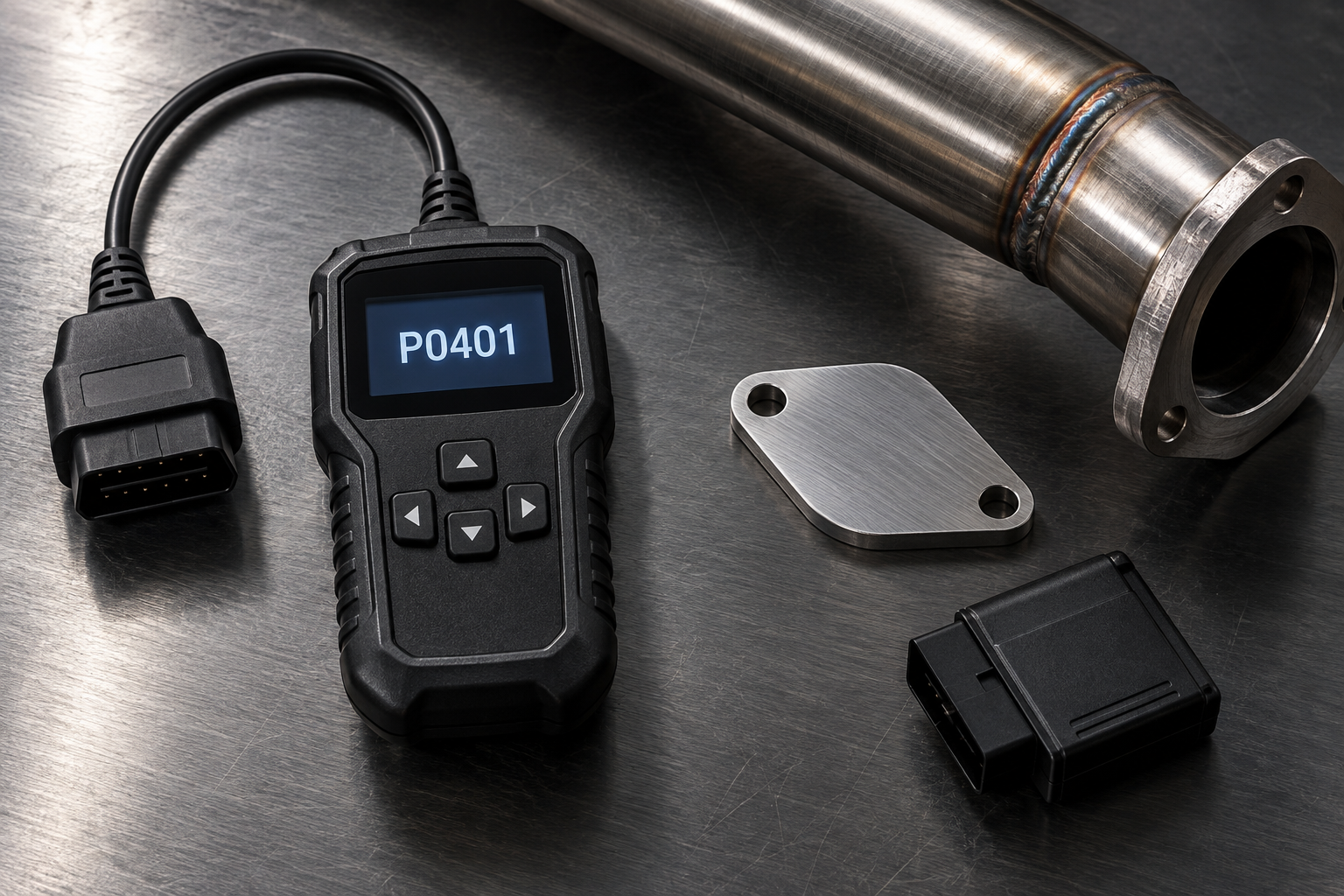
If you own a Ford Super Duty with the 6.7L Powerstroke diesel, there's a good chance you've already dealt with an EGR problem, or you will. The Exhaust Gas Recirculation system is one of the most well-documented weak points on these trucks, affecting 2011–2025 F-250, F-350, F-450, and F-550 owners alike. Whether you're chasing a rough idle, a disappearing coolant level, or a check engine light flashing P0401, this guide covers everything you need to diagnose, repair, or permanently fix your 6.7 Powerstroke EGR problems.
April 15, 2026

2020-2024 6.7 Powerstroke Delete Kit Buyer's Guide

If you're driving a 2020-2024 Ford Super Duty with the 6.7L Powerstroke, you already know these trucks are built to haul. But you may also know that the Gen 3 emissions stack, including DPF, DOC, SCR, EGR, and DEF, is one of the most complex and failure-prone setups Ford has ever bolted to a diesel. That's exactly why more and more 2020+ Powerstroke owners are researching delete kits tailored for their specific model year. This guide breaks down everything you need to know before buying a 2020-2024 6.7 Powerstroke delete kit: what's in the kit, how it fits your truck, what's genuinely harder on the newer platform, and what kind of performance gains you can realistically expect on the dyno and on the road.
April 14, 2026

2011–2019 6.7 Powerstroke Delete Kit Buyer's Guide

If you're running a 2011–2019 Ford F-250, F-350, or F-450 Super Duty with the 6.7L Powerstroke diesel, you already know this engine was built to work. What it wasn't built for was years of abuse from its own emissions hardware. DPF regens that cook the turbo. EGR coolers that crack and push coolant into the intake. DEF systems that throw fault codes in freezing weather. A failing emissions stack doesn't just cost you money, it kills tow confidence and eats into the engine life you paid for. This guide walks you through everything you need to know before buying a 2011–2019 6.7L Powerstroke delete kit: what each emission system does, what a complete kit includes, how to match the right kit to your exact model year, and what kind of performance gains you can realistically expect.
April 13, 2026

2003-2004 5.9 Cummins Buyer's Guide: Specs, Common Problems & Best Upgrades

The 2003-2004 Dodge Ram equipped with the 5.9L Cummins marked a watershed moment in diesel truck history. These were the first model years to ditch the old mechanical P7100 injection pump in favor of a Bosch CP3 high-pressure common rail (HPCR) fuel system — and that one change rewrote the rules for what a diesel pickup could do. Whether you're shopping for one of these trucks right now or already own one and want to get the most out of it, this guide covers everything you need to know: factory specs, known weak points, maintenance intervals, and the upgrades that actually move the needle.
April 12, 2026

What Breaks and How to Fix It: 2003–2007 Dodge Ram 5.9L Cummins

If you own or are shopping for a 2003–2007 Dodge Ram 2500 or 3500 with the 5.9L Cummins, you already know you're dealing with one of the most capable diesel engines ever bolted under a pickup hood. The third-gen common-rail Cummins is a favorite for towing, daily driving, and high-horsepower builds. But "legendary" doesn't mean "bulletproof." There are specific weak points in these trucks that every owner needs to know about before they end up stranded on the side of the road. This guide covers the most common 2003–2007 Dodge Ram 5.9 Cummins problems, what causes them, how to fix them, and what you can do to prevent them from happening in the first place.
April 11, 2026

2006–2007 LBZ Duramax Buyer's Guide: Specs, Common Problems & Best Upgrades

If you're shopping for a used diesel truck, the 2006–2007 LBZ Duramax is one of the first engines you'll hear people recommend. Among GM diesel fans, the LBZ Duramax is often seen as the sweet spot: strong factory power, excellent reliability, solid aftermarket support, and fewer emissions-related headaches than later trucks. It has enough horsepower to feel modern, enough simplicity to stay appealing, and enough tuning potential to make it one of the most desirable Duramax platforms ever built. But buying an LBZ today is different than buying one 10 years ago. These trucks are older now, mileage is higher, and condition matters more than reputation alone. A clean, well-maintained truck can still be a great buy. A neglected one can turn into an expensive project fast. In this guide, we'll cover the LBZ Duramax specs, the most common LBZ Duramax problems, what to inspect before buying, and the best LBZ Duramax upgrades if you want more power, better reliability, or a stronger towing setup.
April 10, 2026

2001–2004 LB7 Duramax Buyer's Guide: Specs, Injector Problems & Upgrades That Matter

The LB7 Duramax is where GM's diesel legacy began. Introduced in 2001 as a joint development between General Motors and Isuzu, this 6.6-liter turbocharged V8 arrived in the Chevrolet Silverado HD and GMC Sierra HD and immediately reset expectations for what a domestic diesel truck could do. It was quieter, more refined, and more powerful than the competition had any right to expect. Two decades later, LB7-equipped trucks remain a popular choice in the used diesel market — and for good reason. But they carry a well-documented Achilles' heel that can turn a great deal into a costly mistake if you don't know what to look for. This guide covers everything you need to know: what the engine is, what it does well, where it fails, how to inspect one before buying, and how to protect your investment once you own it.
April 09, 2026

What Year Duramax to Avoid: The Complete Buyer's Guide to Known Problem Years (2001–2026)

The 6.6L Duramax diesel has been a staple in GM's heavy-duty truck lineup for over two decades. But not every model year was built equal. Some generations are plagued with expensive, recurring failures that can turn a $25,000 used truck into a money pit overnight. If you're shopping for a used Chevy Silverado or GMC Sierra HD, knowing which Duramax years to avoid — and which ones to target — can save you thousands. This guide breaks down every generation, its known problems, and what to look for before you buy.
April 08, 2026

2019–2021 Ram 6.7L Cummins ECM Unlocking: Why It's Required for Tuning

If you just bought a 2019–2021 Ram 2500 or 3500 with the 6.7L Cummins and tried to plug in EFI Live, HP Tuners, or MM3, you're not alone, and your tuner isn't broken. On pre-2019 Cummins trucks, connecting a tuning device was straightforward. Plug into the OBD-II port, read the ECM, flash the calibration. Done. Starting in 2019, Chrysler added two layers of security that completely changed the process. Until both are addressed, no mainstream tuning platform can safely write to your engine computer. This guide explains exactly what changed, what you need to bypass it, and how to do it without destroying your ECM in the process.
April 07, 2026

2007.5–2012 Ram 6.7L Cummins Delete Guide: What You Need to Know

If you're running an early 6.7L Cummins, you're sitting on one of the most tuner-friendly diesel platforms ever built. No Security Gateway module. No CP4 injection pump ticking like a time bomb. No encrypted ECM requiring a $500 mail-in unlock before a tuner will even look at your truck. The 2007.5–2012 Ram 2500/3500 is the generation the aftermarket grew up on — and for good reason. This guide walks you through everything you need to delete and tune an early 6.7, from the parts stack to the common mistakes that turn a clean build into an expensive lesson.
March 31, 2026

Pros and Cons of Diesel Delete Kits

Every diesel truck owner has heard the pitch: remove the emissions hardware, tune the ECU, and unlock the engine's true potential. It sounds straightforward, but the decision sits at a crossroads between mechanical freedom and legal responsibility. A diesel delete refers to physically removing factory emissions control components — such as the Diesel Particulate Filter, Exhaust Gas Recirculation system, and Selective Catalytic Reduction with its Diesel Exhaust Fluid system — combined with a custom ECU reflash that tells the truck's computer those systems no longer exist.
March 25, 2026

6.0L Powerstroke Oil Capacity

If there is one number every 6.0L Powerstroke owner must commit to memory, it is this: 15 quarts. Not 13. Not 14.5. Fifteen — with a fresh Motorcraft FL-2016 filter. Everything else in this guide flows from that single, non-negotiable specification.
March 25, 2026

Understanding the P2509 Cummins Code

Seeing the P2509 code pop up on your Cummins can be incredibly frustrating, especially if it's accompanied by random stalling or a no-start condition. Officially defined as ECM/PCM Power Input Signal Intermittent, this diagnostic code means your engine's computer is repeatedly losing its electrical power supply. While an ECM power failure sounds like a catastrophic and expensive repair, the reality is usually much simpler. Before you start pricing out a new computer, take a deep breath. In most cases, the P2509 code is triggered by basic electrical gremlins like corroded battery terminals, a failing battery, or a bad ground connection. In this guide, we’ll break down exactly what causes this intermittent code, the common symptoms to watch out for, and a step-by-step diagnostic plan to help you track down the issue and get your diesel reliably back on the road.
March 12, 2026

6.7 Powerstroke DPF Delete Guide

The Ford 6.7L Powerstroke diesel engine is a powerhouse known for its exceptional torque, towing capability, and durability in demanding applications. However, it is also a highly complex emissions-controlled system designed to meet stringent federal standards. ​This guide is written exclusively for off-road enthusiasts, work truck owners, or performance seekers using vehicles on private off-road property only, fully aware of legal risks. It's not for daily drivers or public-road users.
March 02, 2026

Unlock Your Diesel's True Potential: EGR Delete Benefits for Powerstroke, Cummins & Duramax

Modern diesel trucks are engineering marvels, built for massive torque and legendary towing. However, many owners find their truck’s true potential choked by factory emissions systems. Is your 6.7L Powerstroke feeling sluggish? Are you concerned about fuel dilution in your Cummins? Do you wish your Duramax had the sharp, factory-fresh throttle response it once did? All of these issues may point to a single solution: an EGR delete. In this guide you’ll get a clear, platform-by-platform breakdown of exactly what an EGR delete does, the specific problems it solves on each engine, and the real-world benefits you can expect.
February 28, 2026

EGR Delete Pros and Cons: Everything You Need to Know About The EGR System

If you drive a diesel truck, you’ve likely heard about the pros and cons of EGR delete. Some owners claim it improves engine performance and reduces soot buildup, while others warn about legal risks and increased emissions.An EGR delete removes or disables this system, often using delete kits and ECU tuning. In this guide, we’ll break down everything you need to know — including performance impact, reliability, legal concerns, and whether deleting your EGR system is the right choice.
February 10, 2026

6.7 Powerstroke Oil Capacity & Maintenance Guide

The 6.7L Powerstroke diesel engine is the backbone of many Ford Super Duty trucks, known for its durability, towing capability, and long service life. At the center of keeping this engine running smoothly is oil capacity.This guide breaks down the 6.7 Powerstroke oil capacity by model year, explains the correct oil level check process, and covers oil type, oil change best practices, and the most common mistakes that can lead to engine damage.
February 09, 2026

Ultimate Guide to 7.3 Powerstroke Oil Capacity and Maintenance

The 7.3L Powerstroke is renowned for durability. Proper oil maintenance is crucial for the 7.3, as it uses a HEUI system where oil aids injector operation, not just lubrication. Keeping the correct oil level, using the right oil, and regular changes are essential for long engine life.This guide applies to all 7.3L Powerstroke trucks, including the OBS models (1994.5-1997) and Super Duty models (1999-2003) with exact oil capacity specs, the best oil types (15W-40 vs. 5W-40, CK-4), and DIY oil change steps.
December 09, 2025

How to Choose Delete Kit for a 2011-2019 6.7L Powerstroke on EngineGo

Your Ford Super Duty’s 6.7L Powerstroke can gain significant power and reliability by removing restrictive emissions components. This guide shows how to confirm your truck’s year and model and then find the matching delete kit on enginego.com.