LB7 Duramax Engine Specs
Before diving into problems, it helps to understand what you're working with. The LB7's architecture was genuinely advanced for its time and holds up well by modern standards.
| Specification |
Detail |
| Displacement |
6.6L (403 ci) V8 |
| Configuration |
32-valve, DOHC, aluminum cylinder heads |
| Fuel System |
Bosch CP3 common-rail direct injection |
| Injector Layout |
Centrally located, 4 per cylinder |
| Turbocharger |
Wastegated IHI turbocharger |
| Power Output |
300 hp @ 3,100 rpm |
| Torque |
520 lb-ft @ 1,800 rpm |
| Compression Ratio |
17.5:1 |
| Production Years |
2001–2004 |
The Bosch CP3 injection pump at the heart of this system is one of the most reliable high-pressure diesel pumps ever put to production use. When fed clean, pressurized fuel, it routinely lasts 300,000 miles or more. The problem isn't the pump — it's everything upstream and downstream of it.
The Big Problem: LB7 Injector Failure
There is no way to write an honest LB7 buyer's guide without making injector failure the centerpiece. This is the issue. It defines the generation, shapes the resale market, and determines whether you're getting a deal or inheriting a disaster.
Why the Injectors Fail
The original Bosch injectors fitted to LB7 engines had manufacturing defects that caused the injector bodies to crack internally and the needle-and-seat assemblies to deteriorate prematurely. When this happens, fuel leaks into the crankcase, causing the oil level to rise — and crankcase dilution to accelerate engine wear. Injector cup seal failures add another failure mode: when the cups leak, coolant can enter the combustion chamber, and you're looking at a much larger repair.
How to Diagnose It Before You Buy
The fastest pre-purchase check is the dipstick. Pull it. If the oil is overfull, smells strongly of diesel, or looks unusually thin and dark, you are almost certainly dealing with leaking injectors. Other symptoms include:
- White or gray haze at idle on a warm engine
- Rough idle, misfires, or surging
- Hard starts, particularly in cold temperatures
- Unexplained loss of power under load
- Diesel odor from the oil filler cap
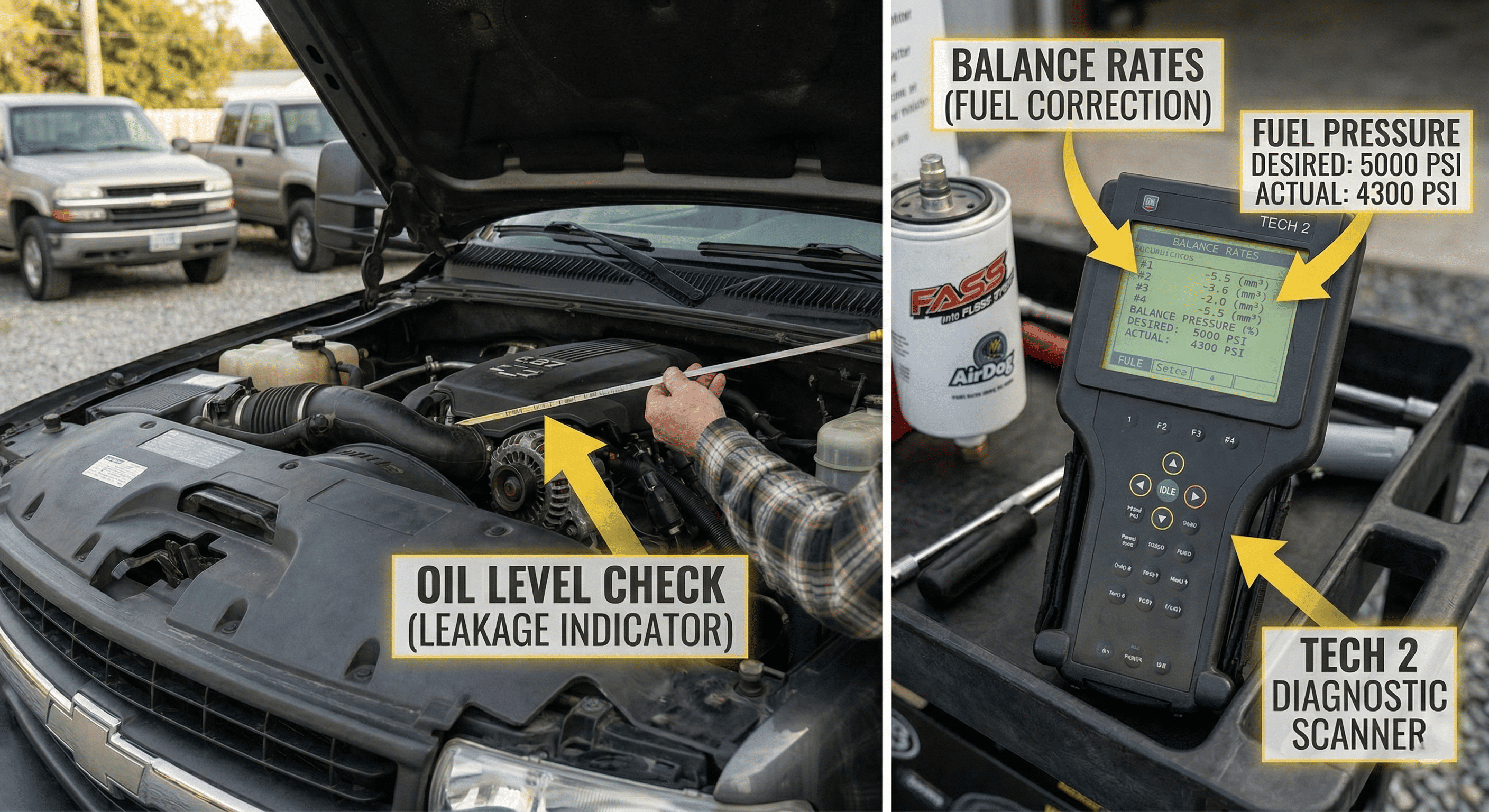
For a definitive answer without pulling valve covers, ask a diesel shop to perform an injector balance rate test using a Tech 2 scanner or equivalent. This reads the fuel correction each injector is applying in real time. Wide variation between cylinders — or large negative correction values — points to injector wear or failure.
What It Costs to Fix
A set of eight remanufactured LB7 injectors runs $2,000–$3,500 for parts. Because the injectors sit beneath the valve covers and require substantial disassembly to access, labor adds another $1,000–$1,500 at a competent diesel shop. Budget $3,500–$5,000 for a full injector replacement if you're paying someone else to do it.
GM acknowledged the defect and extended the factory warranty on LB7 injectors to 200,000 miles or 7 years for original owners. On trucks this age, that coverage is gone. What matters now is whether a given truck has had them replaced — and whether you can prove it.
The rule: Always ask for documentation of injector replacement. If records don't exist, price the truck accordingly. A truck where injectors were replaced with quality components and the job is documented is genuinely worth more than one where the seller "thinks they were done."
Other Known LB7 Problems
Fuel System Air Leaks & O-Ring Failures
The fuel filter housing O-rings dry out and crack with age, introducing air into the fuel circuit. Air in the system causes hard starts, rough running, and — critically — increases the rate of injector wear by forcing the CP3 to work without consistent prime pressure. Replacing these O-rings is inexpensive, but identifying the problem requires knowing what to look for.
Head Gasket Failure
The LB7's aluminum heads are capable but not immune. Head gasket failure typically presents as coolant loss without visible external leaks, oil contamination in the coolant overflow tank, or persistent white exhaust smoke after full warmup. High-mileage trucks and any engine that has been overheated are higher risk. A coolant system pressure test is a worthwhile step on any candidate above 150,000 miles.
Cracked Water Pump Gear
A less-discussed but genuine LB7 failure point is the plastic water pump drive gear, which cracks with age and heat cycling. If it fails, the water pump stops moving coolant — and the consequences are immediate. Any major engine service is a good time to replace the water pump and its gear as preventive maintenance. It's cheap insurance against a preventable overheating event.
Glow Plug Degradation
Cold-start performance degrades as glow plugs age. On trucks approaching 150,000+ miles, expect worn glow plugs. Stuck plugs are a real risk on high-mileage diesel engines — they can break during removal — so diagnosing this before the plugs are an emergency is worth the effort.
CP3 Pump Wear (on neglected trucks)
The CP3 itself is highly reliable, but neglect accelerates wear. Trucks that ran contaminated fuel, had chronic air intrusion, or operated for extended periods without adequate lift pump support may have a worn CP3. Listen for whining, cavitation noise, or inconsistent fuel pressure symptoms at idle.
Pre-Purchase Inspection Checklist
Use this checklist on any LB7 candidate before committing:
- Cold start: Start it cold. Watch for white/gray smoke, rough idle, difficulty cranking.
- Warm idle smoke: After full warmup, any sustained haze at idle is a red flag.
- Dipstick check: Is the oil overfull? Does it smell like diesel? Signs of injector leak.
- Coolant overflow tank: Any oil residue, soot, or discoloration suggests head gasket issues.
- Injector balance rate scan: Have a diesel shop run a Tech 2 scan to check injector health.
- Injector replacement records: Ask specifically, and verify if possible.
- Undercarriage and frame: These trucks are 20+ years old. Rust on northern trucks is a structural concern that can dwarf drivetrain repair costs.
- Allison 1000 transmission: Check for slipping, delayed engagement, and burnt-smelling fluid. The Allison is excellent but not invincible.
- Fan clutch and cooling system: Especially important if the truck is a towing rig.
For any serious candidate, a $150 pre-purchase inspection from an independent diesel mechanic is money that pays for itself many times over.
Essential LB7 Maintenance
The LB7's fuel system is its most sensitive — and most important — system to protect. These habits apply whether you just bought one or have owned it for years.
- Fuel filtration is non-negotiable: The factory filter is a minimum baseline, not a ceiling. Upgrading to a quality aftermarket diesel fuel filtration system with water separation removes the fine particulates and moisture that degrade injectors. Change filters on schedule — or more frequently if you pull fuel from bulk tanks or sources of variable quality. This is the single highest-leverage maintenance step for injector longevity.
- Install a lift pump: The LB7 has no factory lift pump. The CP3 must pull fuel all the way from the tank under its own suction — a design that creates risk of cavitation and air intrusion under any demand condition. A dedicated diesel lift pump (FASS Titanium and AirDog are the established names in this space) delivers consistent, pressurized, pre-filtered fuel to the CP3, dramatically extending both CP3 and injector life. This is the most impactful upgrade you can make to an LB7.
- Oil and coolant intervals: Run a quality diesel-rated engine oil and don't stretch intervals beyond 7,500 miles maximum. These engines run hot under load. Keep Dex-Cool or an equivalent OAT coolant fresh — old coolant turns acidic and eats gasket and sealing surfaces.
Best LB7 Upgrades
ECM / Performance Tune
A quality tune is the highest-value single modification for the LB7 platform. Fueling, timing, boost, and torque management parameters are all adjusted to extract what the factory left conservative. Expect gains of 50–100 hp on a stock engine, plus real improvements in EGT management, throttle response, and towing efficiency. Always pair tuning with supporting hardware — a tune without upgraded fueling and thermal management puts stress on components that weren't designed for higher demand.
Performance Exhaust System
Reducing exhaust backpressure lowers exhaust gas temperatures (EGTs), which directly benefits engine longevity and tuning headroom. An aftermarket diesel performance exhaust starting at the downpipe and running back is a high-value upgrade for any working LB7, especially one used for towing. Lower EGTs mean more margin before you're in a zone where components are stressed.
Cold Air Intake
A performance diesel intake reduces intake restriction and temperatures, helping the IHI turbo spool faster and keeping charge air cooler under load. The gains on a stock engine are modest, but this upgrade earns more when paired with a tune — and it's a simple bolt-on that doesn't require supporting modifications.
Upgraded Fuel Injectors
If you're replacing injectors anyway, consider high-performance diesel injectors rather than stock-spec replacements. Upgraded injectors support higher power levels, flow more fuel at demand, and pair naturally with an ECM tune for a complete fuel system upgrade. Match injector size to your power goals and build level.
Lift Pump System
Already covered under maintenance, but worth stating as an upgrade too: a FASS or AirDog lift pump system is arguably the best single thing you can do for an LB7's long-term health. It protects everything downstream, extends the life of your injectors and CP3, and pays for itself in avoided repairs.
Final Verdict: Is the LB7 Worth Buying?
Yes — if you buy the right one. The LB7 Duramax is a capable, refined, and ultimately durable engine when it's been properly maintained and its known failure points addressed. The Allison 1000 behind it is one of the best automatic transmissions ever fitted to a diesel truck. The CP3 pump, when fed correctly, is nearly bulletproof. The engine architecture was ahead of its time in 2001 and it shows.
The injectors are the variable. Budget for them, verify their status, and insist on documentation. A well-documented truck where injectors have been recently replaced and a lift pump installed is a strong buy. A truck with no records, smoky idle, and an overfull dipstick is a project — price it that way.
Buy with eyes open, maintain the fuel system diligently, and the LB7 will give you years of reliable, capable service.
FAQs
How many miles can a 2001-2004 LB7 Duramax last?
With strict maintenance—especially regarding the fuel system and timely oil changes—an LB7 Duramax can easily exceed 300,000 miles. The engine block and Allison transmission are incredibly robust. Many well-maintained, properly upgraded examples are still pulling heavy loads with over 400,000 miles on the odometer.
Does the LB7 Duramax have emissions equipment like DPF or DEF?
No, and this is one of its biggest selling points. The 2001-2004 LB7 is a "pre-emissions" diesel. It does not have a Diesel Particulate Filter (DPF), uses no Diesel Exhaust Fluid (DEF), and standard federal models lack an Exhaust Gas Recirculation (EGR) valve. This absence of complex emissions equipment makes the LB7 simpler, cheaper to maintain, and highly sought after.
How often do LB7 injectors actually need to be replaced?
Factory original injectors typically begin showing signs of failure between 80,000 and 120,000 miles due to design flaws. However, if you replace them with updated, high-quality remanufactured Bosch injectors and install an aftermarket lift pump to provide highly filtered, pressurized fuel, the replacement set can last significantly longer than the originals.
How much can a 2001-2004 LB7 Duramax tow?
Depending on your specific truck configuration (2500HD vs. 3500HD, and axle ratio), an LB7-equipped truck generally offers a conventional towing capacity of up to 12,000 lbs. For 5th-wheel or gooseneck setups, that capacity can reach up to 15,000 lbs.