What is a Diesel Particulate Filter (DPF)?
The Diesel Particulate Filter (DPF) is a critical component of the truck's exhaust aftertreatment system. It's a ceramic filter designed to trap soot and particulate matter (PM) from the exhaust gas. To prevent clogging, the engine periodically performs a regeneration cycle, injecting extra fuel to raise exhaust temperatures and burn the trapped soot to ash. The DPF works in conjunction with other key systems:
- Selective Catalytic Reduction (SCR): Injects Diesel Exhaust Fluid (DEF) to convert nitrogen oxides (NOx) into harmless nitrogen and water vapor.
- Exhaust Gas Recirculation (EGR): Recirculates a portion of exhaust gas back into the engine's intake to lower combustion temperatures and reduce NOx formation.
Why Consider a DPF Delete for Your 6.7 Powerstroke?
For vehicles whose sole purpose is off-road performance, the potential benefits of removing these systems can be significant:
- Performance Enhancement: Removal of exhaust backpressure typically unlocks 50 to 150+ additional horsepower and torque depending on the tune.
- Improved Fuel Economy: The elimination of fuel-intensive regeneration cycles and reduced exhaust restriction can lead to measurable gains in miles per gallon, especially under load.
- Reduced Maintenance and Operating Costs: Owners save on the recurring cost of DEF fluid and avoid the high expense of replacing failed DPF, SCR, or EGR components, which can cost thousands of dollars.
- Elimination of Common DPF Issues: No more forced regens, limp mode, or clogged-filter check-engine lights that plague stock trucks under heavy use.
The “Before You Delete” Checklist: Essential Considerations for Off-Road Vehicles
This is the most critical section. Proceeding without full acknowledgment of these points is ill-advised.
- LEGAL IMPLICATIONS: This modification violates the Clean Air Act. Fines can exceed several thousand dollars per violation, and in most states the vehicle will never pass annual emissions testing again. Remote diagnostic systems on newer trucks can flag deletes even without a physical inspection.
- Warranty Voidance: Ford will deny any powertrain or emissions-related claims the moment a delete is detected.
- Resale Value Impact: Most serious buyers will walk away or heavily discount a deleted truck; some states require emissions compliance for title transfer.
- Understanding the Risks: Improper tuning can cause catastrophic engine damage (melted pistons, blown turbos). EGR removal can lead to poorer cold-start performance and increased cylinder-head thermal stress.
- Financial Investment: Budget for a quality delete kit, a capable tuning device/programmer with custom off-road tunes, and potential professional installation if you are not doing the work yourself.
Anatomy of a 6.7 Powerstroke DPF Delete: What You’ll Need
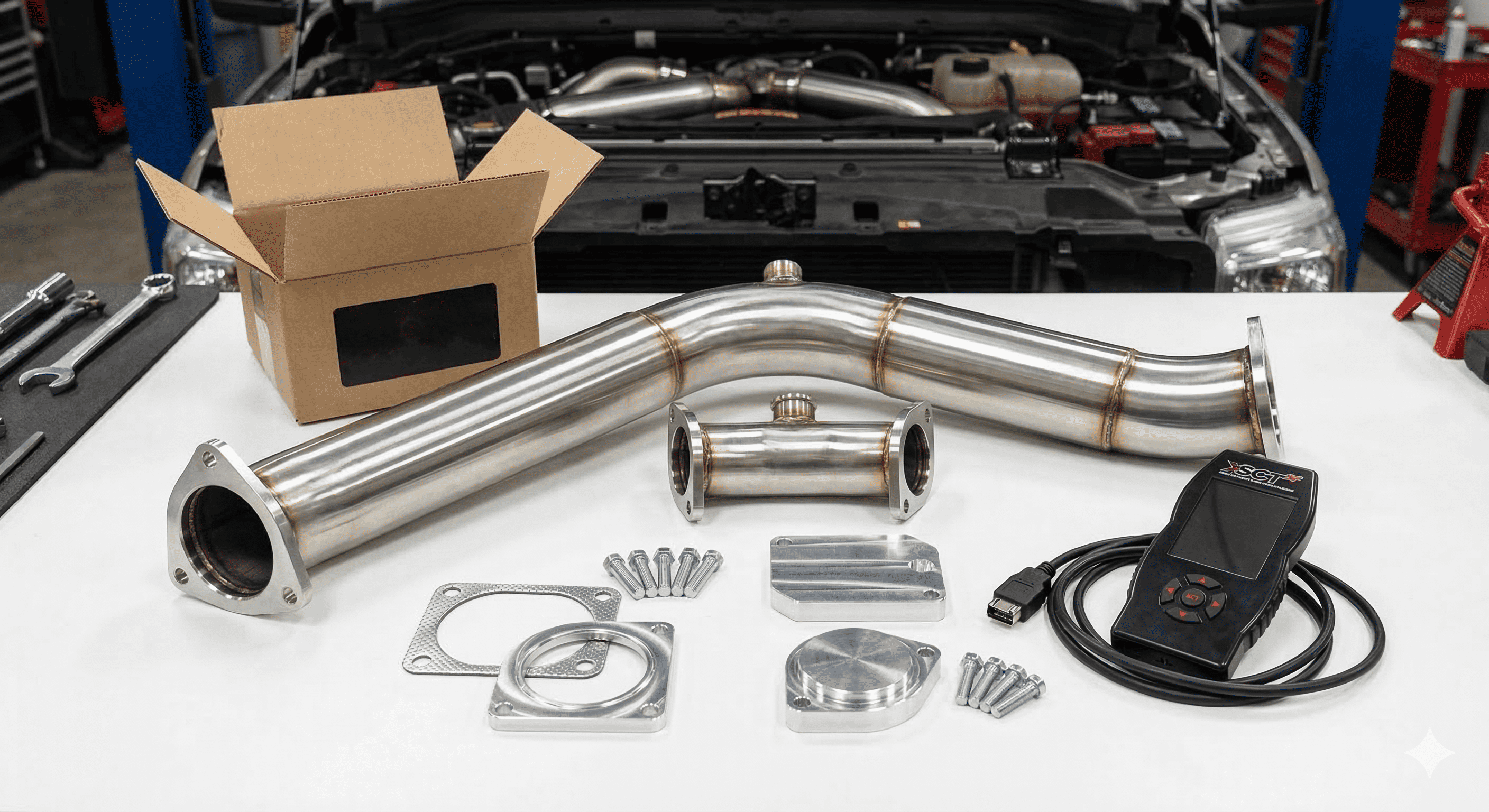
Delete Kit Components
This is the physical hardware. It typically includes a DPF delete pipe to replace the massive DPF/SCR assembly. For those seeking a seamless installation, utilizing all-in-one 6.7 powerstroke delete kits is the most efficient way to ensure all necessary piping and hardware are compatible with your specific model year.
EGR Delete Kit
This usually includes block-off plates for the EGR cooler and a delete pipe for the EGR valve up-pipe. Doing this at the same time is highly recommended for a complete solution.
The Crucial Tuning Device
The hardware is only half the job. A tuning device (e.g., from companies like SCT, H&S, EZ Lynk) loaded with custom off-road only tune files is absolutely essential. The tune tells the engine computer (PCM) to operate without the emissions equipment, preventing constant fault codes and limp mode.
Tools and Preparation
Before you touch a single bolt, gather everything:
- Heavy-duty hydraulic floor jack + multiple jack stands or a professional lift.
- Penetrating lubricant (PB Blaster, Kroil, or similar — soak bolts the night before)
- O2 sensor socket (7/8″ or 22 mm thin-wall)
- Complete metric socket set (8 mm–19 mm), deep sockets, ½″ and ⅜″ ratchets, long extensions, breaker bar
- Torque wrench (0–150 ft-lbs range)
- Exhaust hanger removal tool or large pry bar
- Pliers, wire cutters, zip-tie assortment
- OBD-II scan tool or laptop with tuning software
- Safety equipment: nitrile gloves, safety glasses, steel-toed boots, respirator (for exhaust dust)
- Assistant (strongly recommended — many exhaust sections weigh 60+ lbs and require two people)
- Shop light, drain pan, rags, and thread locker
Note: Steps involving the full exhaust system are far easier on a lift. Attempting this on jack stands alone is risky and time-consuming.
Step-by-Step Guide: Performing the 6.7 Powerstroke DPF Delete
- Safety First: Park on level ground, disconnect batteries, and wear full PPE.
- Disconnect Sensors: Unplug all O2, NOx, temp, and pressure sensors.
- Hardware Removal: Carefully remove the exhaust from the turbo outlet back through the DPF/SCR section.
- Installing the Delete Pipe: Bolt the new delete pipe in place using new gaskets and proper torque specs.
- ECU Tuning: Load your off-road tune before removing any hardware to avoid bricking the ECM.
Optimizing Your Deleted 6.7 Powerstroke
Understanding Your Off-Road Tune
Quality delete tuners offer multiple maps:
- Economy: Focuses on drivability, fuel efficiency, and safe Exhaust Gas Temperatures (EGT) for hauling.
- Performance: Maximizes power and throttle response for off-road use. Requires vigilant monitoring.
Proactive Maintenance for a Deleted Truck
Deleted trucks often perform harder. Increase your maintenance frequency:
- Oil and filter changes every 5,000 miles
- Fuel filter changes every 15,000 miles
- Regular intake and intercooler inspections
- Keep an eye on turbo and injector health
Advanced Troubleshooting
Common post-delete issues include check-engine lights from unplugged sensors, exhaust leaks, or over-boost. Most are resolved with proper tuning updates or sensor simulators.
FAQs
How long does a DPF delete typically take?
6–12 hours for a competent DIYer; 4–8 hours in a shop with a lift.
Can I revert my truck back to stock emissions systems if needed?
Yes, but it is complex and expensive. Keep every original part, gasket, and sensor in labeled boxes.
Will a DPF delete negatively affect my truck’s overall longevity?
Properly tuned and well-maintained deleted trucks often last longer because they avoid constant regen heat cycles. Poor tuning or neglected maintenance can destroy an engine quickly.
What is the best tuner/programmer for a 6.7 Powerstroke DPF delete?
It depends on model year and goals. Research reputable off-road-only tuning providers with proven support and update policies.
Does a DPF delete make my truck significantly louder?
Yes. You will hear more turbo spool and engine note. A "muffler" or "resonator" version of the delete pipe will be quieter than a straight pipe.
Conclusion
A DPF delete for the 6.7L Powerstroke is a serious modification that offers real performance and reliability benefits for off-road vehicles, but at the cost of legal compliance and warranty. It demands careful product selection, professional tuning, and a commitment to more attentive maintenance.